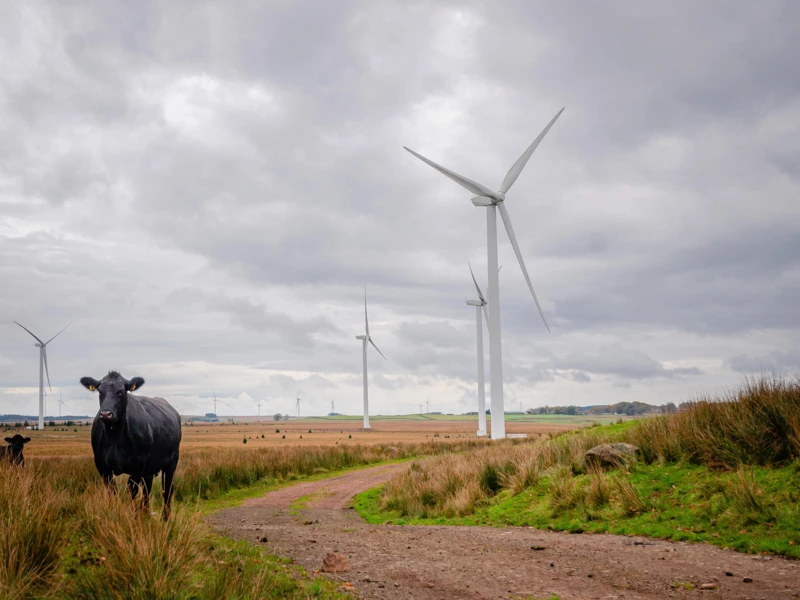
How Onshore Wind Can Help Tackle Scotland's Rural Housing Crisis
A groundbreaking feasibility study published today, Tuesday 12 May, by independent renewable energy developer Muirhall Energy sets out, for the first time, how the onshore wind industry could make a positive contribution in helping to address chronic rural housing shortages - by creating, and converting, construction worker housing into affordable, permanent homes for local communities.
Building upon work by others in the industry, the report, commissioned by Muirhall Energy and conducted by Tinsdale Architects, uses Skye as its primary case study and finds that a legacy housing model could be financially viable for renewable developers depending on project scale and economics, helping to support the delivery of high-quality permanent homes at little or no additional cost when weighted against the expense of temporary worker accommodation.
The study also outlines a number of challenges for developers, such as land availability, consenting timescales and earlier commitment to finance.
Sarah McIntosh, Managing Director of Muirhall Energy, commented:
“Our work with communities highlights the scale of rural housing shortages and the challenges they create. While we cannot make commitments at this stage, this study aims to open a discussion on the opportunities and challenges of delivering housing alongside renewable energy projects.
“The findings suggest community housing can, in some cases, be a more cost-effective option for accommodating construction workers in rural areas, depending on project scale and duration. However, significant challenges remain. Collaboration will be essential, and we invite developers, communities and stakeholders to explore how lasting housing solutions can support both local needs and the transition to a more secure, low-carbon energy system.”
The report acknowledges concerns that large scale construction projects could increase pressure on local housing in some areas, as well as provide challenges for the availability of housing for workers for project delivery and sets out to explore the feasibility of alternative solutions to both issues.
It reveals that:
● For construction projects lasting 18-24 months the cost of building high quality permanent homes could be fully or significantly offset by the budgets routinely spent on temporary worker rentals or modular camps, depending on project scale and construction timescales.
● There are multiple housing options - dependent upon location and need - and mechanisms that could be explored to transfer ownership to community or affordable housing upon project completion, with a mix of these options potentially providing the best solution on a project by project basis.
● It is a transferable model - whilst the report focuses on Skye as a case study, it is applicable to any other rural area with housing pressures, and different types of construction projects, not just renewables.
● Many communities need affordable housing but are under pressure and under-resourced. Supporting community capacity will be key to enabling communities to be active participants.
● Barriers exist, such as planning certainty, project economics, community capacity, supply chain pressures and access to utilities.
Lucie Tinsdale, Director, Tinsdale Architects, added:
“Our research highlights the opportunity to deliver a nationally significant model for worker housing that becomes community wealth building infrastructure and leaves a long-term positive legacy at scale.
“It is a model and process that can be replicated and is applicable to all infrastructure and construction projects, particularly in remote rural areas with a large housing deficit.”
The report brings forward a series of recommendations:
● Adopt a "Legacy-First" Planning Approach: Developers should assess housing needs during the pre-consent phase to align worker requirements with local community aspirations.
● Utilise Diverse “Exit Strategies”: To balance community legacy and project viability, developers should explore a range of transfer models.
● Collaborative Funding: Engage with Local Authorities, Registered Social Landlords (RSLs), government organisations and others to explore the "cost vs. value" gap and partnership approaches.
● Policy Integration: Policy-makers should consider streamlining planning for projects that deliver a broader community legacy such as community housing.
● Building community capacity: Support and independent advice for communities is needed to help build capacity and expertise on the potential for housing legacy.
Jenny Davies, Associate Director for Place, Housing and Economic Investment, Scottish Futures Trust, commented:
“Thanks to Muirhall Energy and Tinsdale Architects for publishing this important piece of early-stage analysis, providing invaluable insight into both the opportunities and challenges through the lens of the onshore wind industry.
“This work has been developed in close parallel with a broader programme of work being led by Scottish Futures Trust to create a scalable, cross-sector framework for workforce legacy housing across Scotland - work in which Muirhall Energy has been a useful contributor and an active collaborator.”
The key findings of the report, Exploring Housing Opportunities and Barriers in Skye: A Feasibility Study for Developers and Communities can be accessed here.
A Gaelic version will be available on request.